








By collaborating with universities, research institutes and hospitals, our senior researchers supervise students undertaking original research. There aren't many things we love more than hearing their fresh ideas!
Open the dropdown menu below to browse the latest group of student projects, or scroll down to hear some of our students' stories.
Student projects list
- 2024-25 projects
Students who are supported by external scholarships are shown with an asterisk, if they have suspended their degree they are shown with a dagger and Lifeblood supervisors are shown in bold.
Supervisors who are shown with a double dagger suspended their supervision in August 2024.
Student name Project title Degree Institution Supervisors Francesco Amico*† Association between blood donor demographics and post-injury multiple organ failure after polytrauma, a state-wide analysis PhD The University of Newcastle Dr Rena Hirani, Prof Zsolt Balogh Anne-Marie Christensen Extracellular traps and TRALI: more than just neutrophils PhD Queensland University of Technology Prof Robert Flower, A/Prof John-Paul Tung, Dr Melinda Dean, Prof Damien Harkin Abigail Edwards* (Completed) A psychological ownership and identity approach to motivation in blood donation PhD The University of Queensland Prof Barbara Masser, Dr Rachel Thorpe, A/Prof Fiona Barlow Astrid Nausa Galeano Bioengineering a Bone Marrow Mimicry for Cell Therapy Manufacturing PhD The University of Queensland Dr Becky Griffiths, Dr Rose Ann Franco, Prof Mia Woodruff, Prof Justin Cooper-White, Dr Mark Allenby Katie Gould Red blood cell alloimmunisation of pregnant women in Queensland and surrounds PhD University of the Sunshine Coast Prof Catherine Hyland, Dr Genghis Lopez, Dr Anna Kuballa, Kylie Fitch, Dr Anne Houghton, Prof Lin Fung Ji Hui Hwang (Completed)* Investigating the role of extracellular vesicles in blood components and their impact on coagulation PhD Queensland University of Technology A/Prof John-Paul Tung, Prof Robert Flower, Dr Natalie Pechiniuk, Prof Damien Harkin Lauren Litchfield* Platelet concentrates and cryopreservation as an alternative storage method: Potential impact on transfusion-related acute lung injury (TRALI) PhD University of the Sunshine Coast A/Prof John-Paul Tung, Dr Filip Radenkovic, Dr Sarah Bajan, Dr Anna Kuballa, Prof Lin Fung Janhavi Mahajan* Addressing the limitations associated with cold storage of platelets to support implementation into routine practise PhD University of Technology, Sydney A/Prof Lacey Johnson, A/Prof Matthew Padula Yasmin Mowat (Completed)* A population based survey examining knowledge, attitudes and perceptions of blood donation eligibility in Australia PhD The University of New South Wales Prof Barbara Masser, Dr Bridget Haire, Prof John Kaldor, Dr Skye McGregor Ashfaque Quadir Personalising red cell transfusion practices to improve patient outcomes in paediatric critical care PhD University of Sydney Prof Alistair McEwan, Dr Marino Fiesta, Prof Robert Flower, Dr Himanshu Popat Rosemary Rasmussen Australian blood donors: Looking back in preparation for the future PhD University of the Sunshine Coast Prof Barbara Masser, Dr Rachel Thorpe, Prof Lin Fung, A/Prof Helen Faddy Laura Marcela Rey Gomez* Developing a novel point of care test for blood analysis PhD Macquarie University Dr Rena Hirani, Prof Yuling Wang, A/Prof Andrew Care, A/Prof David Inglis Michelle Roets (Completed)* Intraoperative cell salvage as an alternative to allogeneic (donated) blood transfusion: An evaluation of the immune response profile PhD The University of Queensland Dr Melinda Dean, A/Prof David Sturgess, A/Prof Louisa Gordon, A/Prof Kerstin Wyssusek, Prof Andre Van Zundert, A/Prof John-Paul Tung Robert Smith* Blood donation and time preferences: Unravelling altruistic choices and temporal decision-making PhD University of Nottingham Prof Eamonn Ferguson, Prof Chris Stamer, Prof Barbara Masser, Prof Liam Delaney Ivy Tan* Closed Veins: Understanding the Experiences and Psychosocial Impact of Permanent Deferral in Older Donors PhD The University of Queensland A/Prof Theresa Scott, Prof Barbara Masser, Dr Rachel Thorpe Stella Tan* Mechanisms to encourage word of mouth PhD The University of Queensland Dr Kathleen Chell, Prof Barbara Masser,‡ Dr Faiza El-Higzi Amanda Thijsen Examining knowledge translation practices by researchers and research engagement by end-users working in transfusion medicine# PhD The University of Sydney Prof Barbara Masser, A/Prof Tanya Davison, Dr Anna Williamson, Dr Gai Moore Flavia Torres-Vasconcelos* Pandemic threat and natural disasters in Australia: impact on blood supply and potential optimization of a regional strategy to address blood supply restriction PhD University of The Sunshine Coast Dr Elvina Viennet, A/Prof Helen Faddy, Dr Melinda Dean, Dr Katharina Merollini Timothy An (Completed)*† Occult Hepatitis C infection: is there a risk to transfusion safety? MPhil The University of Queensland Prof Robert Flower, A/Prof Helen Faddy, Dr Melinda Dean Pauline Dizon Understanding the impact of Stem Cell Factor glycosylation on cell signalling and stem cell differentiation MMedRes Griffith University Dr Becky Griffiths, A/Prof Daniel Kolarich Anastazia Keegan Viscoelastic properties of cold-stored platelets using novel viscoelastic haemostatic assays and clinical implications for bleeding patients MSc (Research) University of Technology, Sydney A/Prof Lacey Johnson, A/Prof Matthew Padula Isabelle Lightbody* Improving the monocyte monolayer assay (MMA) MSc University of the Sunshine Coast A/Prof John-Paul Tung, Dr Melinda Dean, A/Prof Helen Faddy Ching Li (Crystal) Lim Extended metagenomic analysis of bacterial contamination screening pooled platelets. MPhil Queensland University of Technology Dr Eileen Roulis, Prof Robert Flower, Dr Alison Carey Dr Genghis Lopez Genotype frequencies for human platelet antigens in an Australian blood donor population MPH Queensland University of Technology Dr Kaeleen Dingle, Dr Elvina Viennet, Gail Pahn, Prof Catherine Hyland Wil Losereewanich* (Completed) Lab-on-a-bag: engineering an in vitro diagnostic device for automated blood typing# MEng Macquarie University Dr Rena Hirani, A/Prof David Inglis, Prof Yuling Wang Sanjana Nair Exploring preferences of blood donors with high ferritin for genetic testing through blood donation MGen Coun The University of Melbourne Dr Rachel Thorpe, Joshua Schultz, Dr Emma Palfreyman Stacie O’Brien (Completed) Blood group genomics of the Norfolk Islander population MSc Queensland University of Technology Dr Shivashankar H Nagaraj, Prof Robert Flower Natasha Philip (Completed) Cord Blood feasibility study MLab Med Central Queensland University Roxina Sharma, Dr Sara Chiaretti, Denisse Best Mia Sarri Evaluation of new Massively Parallel Sequencing (MPS) chemistry for Non-Invasive Prenatal Testing (NIPT) of fetal red blood cell (RBC) and human platelet antigen (HPA) status MDiag Gen Queensland University of Technology Prof Catherine Hyland, Dr Genghis Lopez, Prof Robert Flower Amelia Taylor* Effect of the COVID-19 pandemic on the healthy human blood donor virome in Queensland Australia# MPhil Queensland University of Technology Dr Eileen Roulis, Prof Kirsten Spann, Prof Robert Flower Shani Visagie† Non-invasive prenatal testing of cell-free DNA in maternal plasma MSc University of The Sunshine Coast Prof Catherine Hyland, Dr Genghis Lopez, Prof Lin Fung, Dr Sarah Bajan Wendy Walker* Examining the frequency of human neutrophil and platelet antigen alleles within different populations groups# MPhil Queensland University of Technology Dr Eileen Roulis, Prof Robert Flower, A/Prof Tony Parker Samuel Campbell Evaluating the impact of word-of-mouth training on the effectiveness of blood donation communication BPsych (Hons) The University of Queensland Prof Barbara Masser Jade Davis Sharing About Blood Donation online BPsych (Hons) The University of Queensland Dr Kathleen Chell, Prof Barbara Masser Lottie Lynch (Completed) Motivations for genetics research participation and blood donation in ethnic minority communities in Australia BSc (Hons) The University of Melbourne Dr Rachel Thorpe, Dr Danya Vears, Dr Samantha Croy Janhavi Mahajan (Completed) Exploring the factors influencing the balance between haemostasis and fibrinolysis in cold-stored platelets BSc (Hons) University of Technology Sydney A/Prof Lacey Johnson, A/Prof Matthew Padula Maya Pinn (Completed) Motivations for genetics research participation and blood donation in ethnic minority communities in Australia BSc (Hons) The University of Melbourne Dr Rachel Thorpe, Dr Danya Vears, Dr Samantha Croy Anthea Walker (Completed) Investigating the utility of monoclonal anti-RhD antibodies as a quality control standard in monocyte monolayer assays BBiomedSc (Hons) University of the Sunshine Coast Dr Melinda Dean, A/Prof Helen Faddy, Dr Alexis Perros, Prof Robert Flower, Dr Sandra Sowah, Prof Catherine Hyland Jorga Kircher (Completed) Assessing the impact of climate change on blood safety and sufficiency: A Scoping Review Special Research Project University of Sunshine Coast A/Prof Helen Faddy, Dr Melinda Dean, Dr Elvina Viennet Professional and Community Engagement Unit (all students participated, around 78 in all, completed) Donor experience of the future BMedSc Macquarie University Prof Michelle Power, Dr Alison Gould, Rochelle Quinlan
3 Column Content & Image Tiles
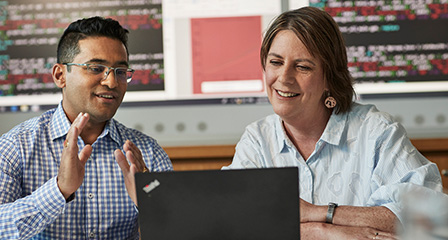


Post graduates
Interested in pursuing post graduate studies with us? Tell us about yourself and your interests.
Email usStudent researchers
Part of helping Australians means planning for a bright future.
When it comes to training the next generation of researchers, our Research team is eager to play their part. With our decades of experience in a range of things from blood to microbiota, it only makes sense to pass that knowledge on to the next generation (along with some tips and tricks of the trade).
Some of our senior staff act as mentors for students who are studying science, technology, engineering and maths (often known as STEM), and to international students.
Research Director Prof David O. Irving says it best, “We are trying to encourage some of the brightest emerging researchers to train in research relevant to the blood sector. It helps to strengthen our collaborations with universities, ultimately makes us more competitive, but most of all it’s a great pleasure to see these bright young scientists join our team.”
Student researchers profiles
Ashish Shrestha
One of our research students, Ashish Shrestha, came to us from Nepal while he was working on his PhD supported by the University of Queensland International Scholarship.
During his final year of research, he was picked for I TRY IT, a global training program developed by the International Society of Blood Transfusion (ISBT) Transfusion-Transmitted Infectious Disease (TTID) Working Party. The aim is to teach young researchers to develop, review and report on research projects in transfusion-transmitted infectious diseases. Ashish was enthusiastic about his experience.
“We had an opportunity to learn from experts from the US, Germany and South Africa. The program included webinars and face to face meetings at ISBT regional conferences in London and Bali.”
“I believe I chose the right place to get involved in research. Lifeblood is an amazing place to explore ideas. With the availability of experts, and friendly and co-operative staff, it’s certainly an ideal place to learn and develop your ideas and skills.”
Htet Htet Aung and Ben Wood
After a year of practical training at Lifeblood to complete their university degrees, Htet Htet Aung and Ben Wood stepped up and joined the team as full-time employees.
“In my country the education system is not really advanced, and I realised that in Australia I could have more opportunities and be quickly independent,” she said.
After arriving in Australia from Myanmar, Htet Htet completed a Bachelor of Medical Science (Honours) at Queensland University of Technology. In her final year, she honed her research skills with Dr John Paul Tung in Lifeblood’s Queensland laboratories. Htet Htet’s research project examined how the storage of red blood cells can lead to changes in their clot-forming ability.
“I like that [Lifeblood] is supportive, collaborative and a really nice environment”.
After completing her honours degree, Htet Htet applied for a Research Assistant role in Sydney. She was successful, and has been a key part of the Sydney research team ever since. She now works with Dr Joanna Tan investigating the properties of red cells under various storage conditions.
Ben Wood spent 2015 completing the practical side of his degree with Dr Lacey Johnson in Sydney, exploring changes in platelets as a result of cold storage, finishing his Master of Science (Honours) from the University of Technology, Sydney. He explains his choice to pursue research at Lifeblood, “The work we do here has a direct application. It’s good to have that goal right there in front of you.”
After several years as a research assistant with Lifeblood, Ben started (and completed!) his PhD within our Sydney research team. He recently celebrated his 10th anniversary as Lifeblood team member, and his culinary talents continue to be an unexpected asset to the Sydney team!